
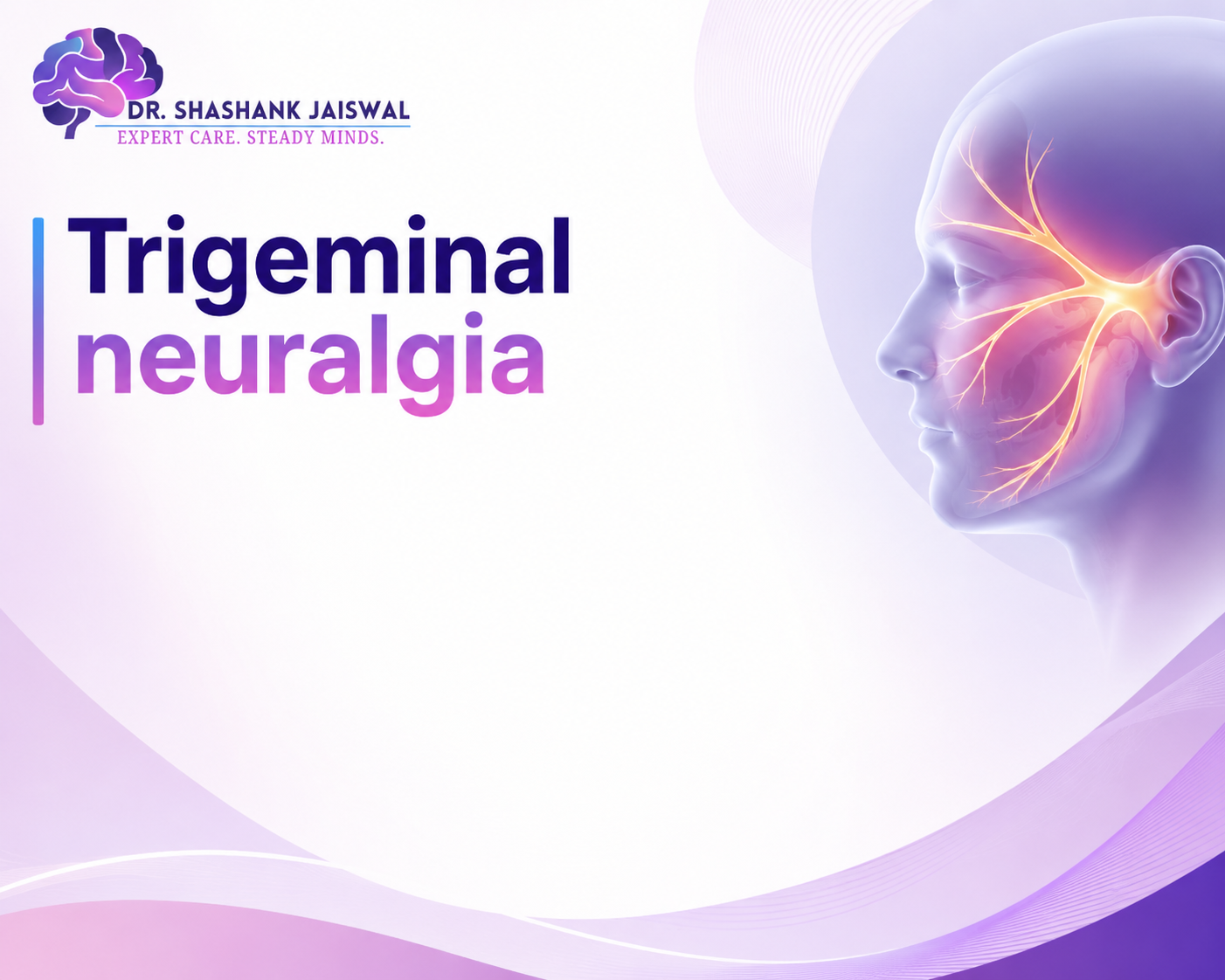
Trigeminal Neuralgia symptoms!
Have you ever experienced a shooting pain with a sudden jolt while touching your jawline that looks like an electric shock? The pain can vanish within seconds, but it is sharp enough to stop you in the middle of an activity.
In the initial stages, many people tend to ignore the pain. They assume the pain is due to a random nerve twinge or tooth sensitivity. Trigeminal neuralgia develops gradually over time.
It begins as moderate and dismissible pain. For this precise reason, many people tend to live with it for months — sometimes longer — before getting the right diagnosis.
Trigeminal neuralgia symptoms: Quick self-check
- Have you had brief, shock-like or stabbing facial pain that lasts only seconds, on one side of your face?
- Does it seem to get triggered by ordinary actions — brushing your teeth, chewing, talking, shaving, or even a light breeze on your face?
- Have you noticed unusual tingling or prickling in one specific spot before or between episodes?
- Has a dentist or doctor previously attributed the pain to a tooth or TMJ issue that treatment didn’t actually resolve?
If this sounds familiar, it’s worth understanding the underlying mechanism — because the earlier this condition is correctly identified, the more treatment options stay on the table.
What’s Actually Happening in the Nerve
The trigeminal nerve is the fifth cranial nerve, and it’s responsible for sensation across three regions of the face: the forehead, the cheek and jaw, and the lower jaw and chin. In most cases, trigeminal neuralgia develops when a blood vessel — usually an artery — presses against this nerve near where it exits the brainstem. Over time, that repeated mechanical contact wears down the myelin sheath, the insulating layer that keeps nerve signals traveling cleanly. Once that insulation is compromised, ordinary sensory signals can get scrambled into pain signals — which is why something as gentle as a breeze or a light touch can trigger a jolt that feels like a stabbing shock.
Less commonly, trigeminal neuralgia stems from other causes: multiple sclerosis (through a similar demyelinating process), compression from a tumor, an arteriovenous malformation, or — in rarer documented cases — as an initial presenting symptom of systemic autoimmune conditions such as connective tissue disease.
Why the Early Signs Are So Easy to Miss
Reflect for a moment: Have you assumed your facial pain was dental, sinus-related, or just stress, without it ever fully resolving despite treatment for those things? That’s an extremely common early pattern. Initial symptoms are often mild twinges in the face or jaw — easily confused with migraine, dental problems, or TMJ disorder. Early episodes may last only a fraction of a second and vanish just as quickly, making a single incident easy to dismiss entirely. It’s the pattern — brief, one-sided, trigger-related, recurring — that distinguishes this from an isolated toothache.
How the Condition Tends to Progress
Trigeminal neuralgia is generally recognized in two overlapping forms. In paroxysmal TN, attacks are sudden, severe, and stabbing, lasting anywhere from a few seconds to about two minutes, with pain-free intervals in between that can stretch for hours. In TN with continuous pain, episodes are less intense individually but far more frequent, producing a more persistent ache. Left unaddressed, mild early pain has a well-documented tendency to intensify — attacks typically becoming both more frequent and more severe as the underlying nerve compression continues.
When to Seek Evaluation
Because trigeminal neuralgia is diagnosed primarily through history and clinical examination rather than a single definitive test, describing your symptoms accurately matters enormously. Seek evaluation if facial pain is recurring, one-sided, shock-like, and triggered by ordinary activities — particularly if it hasn’t responded to dental or TMJ treatment. A neurologist can distinguish it from overlapping conditions and may order MRI imaging to check for vascular compression or other structural causes.
Treatment Options Once Diagnosed
First-line treatment is typically medication — anticonvulsants such as carbamazepine or oxcarbazepine are standard starting points, with gabapentin, pregabalin, or lamotrigine as alternatives. Their effectiveness can lessen over time for some patients, which is when other options — including microvascular decompression surgery or gamma knife radiosurgery — may be considered for longer-term relief.
The Bottom Line
Trigeminal neuralgia rarely starts loud. It starts as a brief, strange jolt you talk yourself out of taking seriously. Recognizing the pattern early — one-sided, trigger-related, shock-like, recurring — is often what separates a fast, effective treatment path from months of misattributed pain.
One question worth asking yourself: Has a “dental” or “TMJ” pain in your life ever really gone away with treatment for those conditions — or has it just come and gone on its own schedule?
This article is for general educational purposes and does not replace personalized medical advice. If you’re experiencing recurring facial pain, please consult a neurologist for proper evaluation.