A crooked smile that appears out of nowhere is frightening no matter the cause — but Bell’s palsy and stroke are treated on completely different timelines, and mixing them up can cost precious minutes. Here’s what actually separates them.
The One Test That Matters Most: The Forehead
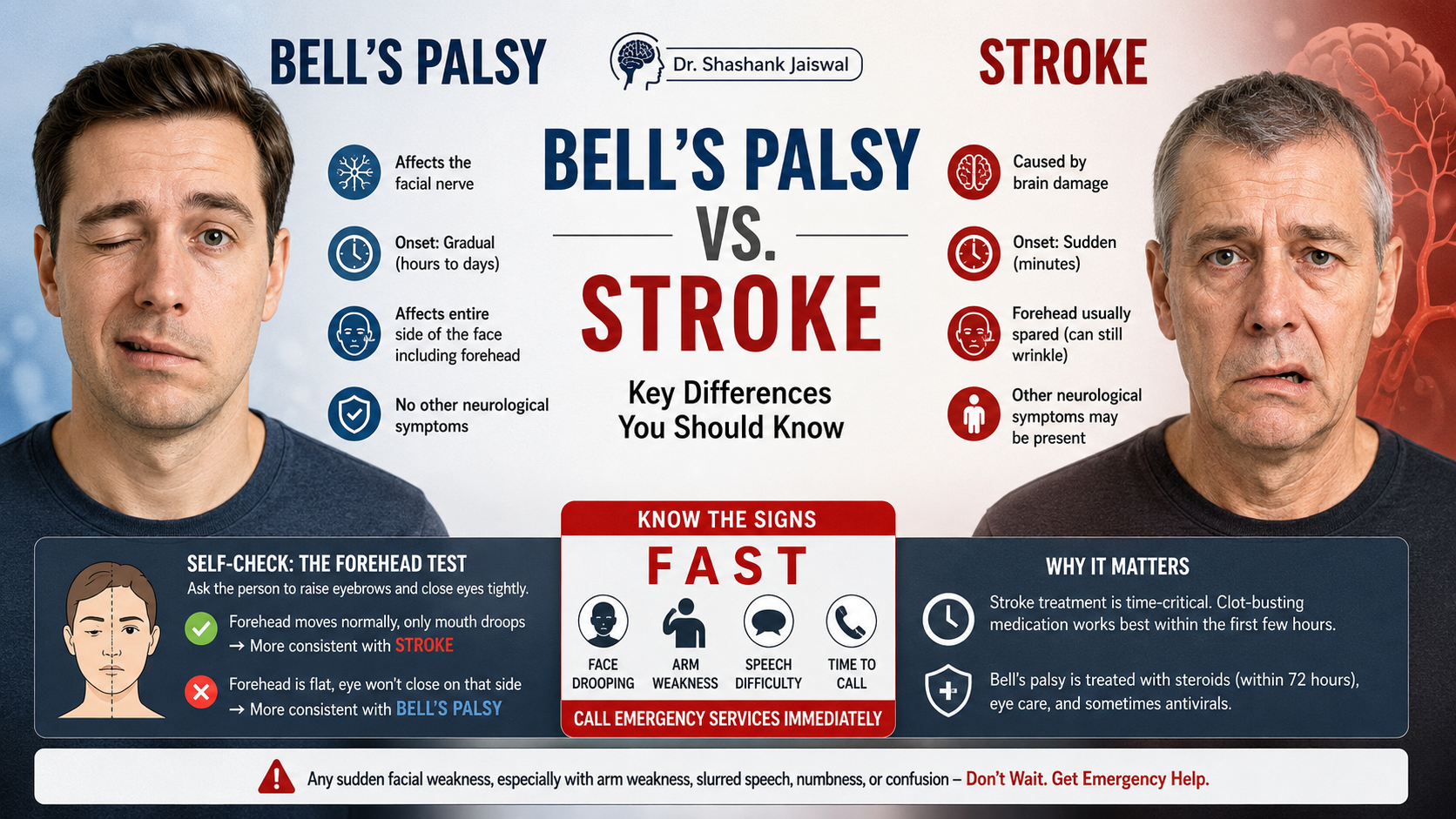
This is the single most useful clue, and it comes down to basic wiring. The forehead muscles receive nerve signals from both sides of the brain, while the lower face is controlled mostly by one side. In a stroke, damage typically occurs in the brain itself, so the opposite hemisphere can still send signals to the forehead — meaning the person can usually still wrinkle their forehead and blink normally on the affected side, even though the mouth droops.
In Bell’s palsy, the problem isn’t the brain — it’s the facial nerve itself, after it exits the brainstem and after both hemispheres’ signals have already merged. That means the entire nerve pathway is disrupted, and the whole side of the face is affected, forehead included. Someone with Bell’s palsy typically cannot raise their eyebrow, close their eye fully, or wrinkle their forehead on the involved side.
Quick self-check: Ask the person to raise both eyebrows and squeeze their eyes shut tightly.
- Forehead moves normally, only the mouth droops → more consistent with stroke
- Forehead is flat and the eye won’t close on that side too → more consistent with Bell’s palsy
Important caveat: strokes affecting the brainstem, rather than the brain itself, can occasionally mimic Bell’s palsy by causing weakness in the forehead, eye, and mouth all together. In these cases, other neurological symptoms almost always accompany it — which is exactly why forehead sparing is a useful clue, not a guarantee.
Onset Speed Tells Its Own Story
Stroke symptoms appear suddenly, often within minutes, and typically peak almost immediately. Bell’s palsy develops more gradually — usually over several hours, sometimes up to a day or two. Someone who went to bed fine and woke up with a drooping face is a classic Bell’s palsy presentation; someone whose face changed visibly within the last 10 minutes needs to be treated as a stroke until proven otherwise.
Beyond the Face: What Else Is Happening?
This is where the FAST test (promoted by the CDC and American Stroke Association) becomes essential, because stroke rarely announces itself through the face alone:
- Face drooping — one side droops when smiling
- Arm weakness — one arm drifts downward when both are raised
- Speech difficulty — slurred, strange, or hard-to-produce speech
- Time to call — if any of these appear, call emergency services immediately
Bell’s palsy is isolated to the facial nerve. It does not cause arm weakness, leg weakness, slurred speech, confusion, or vision loss. If any of those symptoms accompany the facial droop, the working assumption should be stroke, not Bell’s palsy, and emergency care should not be delayed for a “wait and see” approach.
One more distinguishing detail worth knowing: Bell’s palsy does not typically cause numbness. Facial numbness alongside weakness points toward a neurological or vascular cause rather than Bell’s palsy, according to neurologists who study stroke mimics.
Why the Distinction Matters So Much
The two conditions are treated on opposite timelines. Ischemic stroke treatment is time-critical — clot-dissolving medication is most effective within a narrow window of the first few hours, and every minute of delay reduces the chances of a full recovery. Bell’s palsy, by contrast, is typically managed with a short course of corticosteroids started within about 72 hours of onset, sometimes alongside antiviral medication and lubricating eye drops to protect the eye from drying out, since the person may not be able to fully blink.
Because Bell’s palsy can be so visually dramatic, it’s a well-recognized “stroke mimic” — but the reverse mistake is far more dangerous. Assuming a stroke is “probably just Bell’s palsy” and waiting it out can mean missing the treatment window entirely.
The Bottom Line
Sudden, one-sided facial drooping should never be self-diagnosed at home. Forehead involvement, gradual onset, and a lack of other neurological symptoms all lean toward Bell’s palsy — but stroke can occasionally mimic this exact pattern, particularly with brainstem involvement. Any sudden facial weakness, especially combined with arm weakness, slurred speech, numbness, or confusion, warrants an emergency call, not a wait-and-see approach. Imaging (CT or MRI) is often used even when Bell’s palsy seems likely, precisely to rule out the more dangerous possibility first.